A Crash Course in Prague
Essay
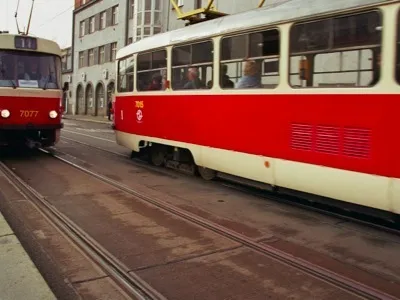
So I spent most of today doing homework, thus I’m going to post my essay instead of anything of consequence...
Furthermore the picture of the trams has nothing to do with anything...
The hand on my wall clock clicks forward one second. Has one second elapsed, or a whole lifetime? How many thoughts did I have in that same second? Did that second even exist outside of the mechanics of the clock? Five more seconds tick by. Mentally I slip from one state of consciousness to another. I have a dream, according to the clock it is five minutes later, but my dream spanned an entire day. Is that reality any less pertinent than the mechanical reality? During that same five minutes that I lay asleep, someone experiences the longest moment of his life. Seconds feel like hours, minutes like days. Is his reality any less pertinent than mine?
The issue with these examples is that time exists outside the physical being. We use time to quantify our lives, yet our psyche uses qualitative means to accomplish the same purpose. Both forms of time are completely valid, and entirely invalid in a simultaneous frame of reference. If clocks did not exist, and time was not quantitative in an external manner, chaos would ultimately ensue. Just as if time did not exist internally one would have no frame of reference as to past events.
Examining this further, and in particular, through the lens of literature, time becomes necessary in both forms in order for an event to have relevance. Literature presents an even more troublesome execution of time in that there is a third party: the reader. This means that time exists in four states simultaneously (although the concept of simultaneous time presents it’s own set of issues, as time changes depending on the reference point). Time exists in both mechanical and biological forms for the reader, so too is it contained within the characters, in both manifestations.
For example, it can take a reader an hour to read a detailed passage that for the character took only seconds to experience. Time has elapsed in all four senses at different rates, thus concluding at different times. Mechanically the reader is an hour later; biologically he may be twenty minutes later. The character contained within the book has experience only a few mechanical seconds, yet has had an experience that lasted, for the sake of argument, several hours, biologically speaking. Thus the reader will have several different interpretations depending on the frame from which he looks.
Through the centuries scientists and psychologists have attempted to quantify, clarify, and develop these discrepancies that are inherent in time. Einstein’s theory of special relativity is one of the most prominent and widely reviewed theories of time. Special relativity attempts to quantify the discrepancies between the mechanical time and the space to which it is applied. Among many other things, this theory was able to prove that time moves slower at higher speeds.
Alan Lightman’s Einstein’s Dreams is about this same theory and the applications and implications that each would have on the way our current world is structured. By that same token Henri Bergson’s Time and Free Will introduces the implications of time on the psyche and furthermore, the time-space relationship on free will. These two works of literature present the ideas surrounding time and free will in a manner that is accessible yet still poignant. However it is important to discuss two things first: what is free will, and why is it relevant.
Free will has been discussed for several centuries, perhaps even longer than time itself has been discussed. Currently there are many theories both for and against free will, which, when defined in general terms, is one’s ability to act on one’s own accord without necessarily regarding prior experiences. Multiple issues arise in each version of free will; they vary from the issue with individual thought, to the issues contained within immeasurable psychological intensities. Free will, its’ existence, or lack there of has implications in religion, physics, and moral responsibility. With the recent introduction of quantum physics and quantum mechanics, free will can have even further implications, or possibly origins, at a level below atomic.
Free will has remained one of the few interconnections between psychology and physics, in that psychology attempts to describe the functions of the brain, the existence of reason, where as physics looks for the reason to describe the function’s purpose in the first place. The physicists’ hope is to derive an equation, a particle, or a force that can explain everything. If this does in fact happen, free will could not exist. If they never find this particle, or instead find an equation that gives a different result with the same numbers every time that equation is calculated, then free will has been proven.
In a 2005 article that discusses this in part, particularly in reference to Bell’s inequality, and the theory of quantum entanglement, describes the problems with quantification: “Quantum theory predicts that the value of either particle's spin only becomes definite if you measure it. But if you measure the spin of one electron and find it to be up, say, that will instantaneously trigger the spin of the other electron to become definite as well, and point down1.” While this concept, of measuring the spin of entangled electrons has little relevance to the question of free will, it must be pointed out that the problem lies within the measurement of the electrons. If they are allowed to exist in a state without measurement, such as the theory of biological time must too exist within this state, then there will never be a quantifiable answer.
Herein lies the relevance to free will, and beautifully illustrates Bergson’s point that this is qualitative reason, that cannot be empirically proven in a quantitative manner. Bergson explains that, “in the immense majority of cases, we decide about the intensity of the effect without even knowing the nature of the cause, much less its magnitude indeed, it is the very intensity of the effect which often leads us to venture an hypothesis as to the number and nature of the causes, and thus to revise the judgment of our senses, which at first represented them as insignificant2.” This consequently proves that while we can never quantify a psychic state, we often, if not always, use qualitative analysis in reference to previous experiences dictating future responses. For example there is no scale of sadness, yet we still say that we are more or less sad, or the saddest we have ever been. So too with other emotions does this hold true. Love is not a quantifiable experience, thus we settle to qualitatively use it to describe another past, or future experience.
Bergson is also keen to explain that often times these emotions manifest themselves in a physical manner. Pain for example; while only one portion of the body may be in pain, the rest reacts, thus giving the illusion of the pain being everywhere, and thus nearly unbearable. Bergson’s essay does a fairly good job of detailing a theory that is not measurable, and hardly testable given the constraints of the testing environment; the concept is the same as the electron spin experiment, except it is in regards to humans as beings.
Lightman also works with Einstein’s idea of mechanical versus body time, claiming that there are two kinds of people: those who listen to their body and ignore the clocks; and those who give orders to their body, and live and die by the clock. The former eats when he is hungry, sleeps when he is tired, and goes to work when he wakes up. The latter has dinner at six, is asleep at ten, and goes to work at seven in the morning. Lightman [in reference to Einstein’s theory] that, “Where the two times meet, desperation. Where the two times go their separate ways, contentment. For, miraculously, a barrister, a nurse, a baker can all make their world in either time, but not in both times. Each time is true, but the truths are not the same3.” This here further illustrates, and for that matter in a more visual way, the two frames of time, and that depending from which frame of reference time is examined, it is true either way. Here again the fundamental issue with quantifying time reoccurs, as if an experiment designed entirely in one time is used to quantify another, the results cannot be valid, at least valid in the most basic sense of the idea.
Thus by this same logic, any and all references that have been written on the ideas of time are entirely invalid. Even the correct theory, illustrating the world as it actually happens, cannot be valid by this argument. Literature exists in space. Words on paper are physical manifestations. However several translation and quantification states are introduced between the idea, the writer, the publisher, the reader, and the reader’s idea. Thus through these two quantification states, that between the writer’s idea and the paper, and the de-quantification between the reader and his idea virtually all meaning is lost. The reader can believe he is understanding what he writer intended, however it is the means that lacks the ability to distribute qualitatively, as is necessarily dictated by the psyche.
In theory this could disprove that literature even exists in the classical sense of the word and the idea. In particular any literature that is about an idea, not an object, would become virtually devoid of meaning. However we have all read books about love and felt love, read about hope and hoped, read about passion and felt passionate. So where is the link? Does literature cut through the two times? Does it prove that free will does exist? Perhaps this is the most notable argument for the necessity of both mechanical and biological time, and their relevance to the system. Free will is not proven nor disproven through the creation of literature, rather is just another facet of the system as a whole. Free will is an idea that exists; it does not require a quantifiable reason to exist as an idea. Even if time eventually is proven, and thus free will effectively disproven, the idea of free will can still exist independently.
This independent existence is how literature is able to translate across the quantification/qualification gap. It is also why literature is interpreted. The idea is quantified as best as the author can through his given medium, while the reader takes that information and quantifies it as best he can. This is where the prior experiences of the reader have great influence on any given piece of literature. Using the inherently problematic feeling of hope, as Bergson describes it, “The idea of the future, pregnant with an infinity of possibilities, is thus more fruitful than the future itself, and this is why we find more charm in hope than in possession, in dreams than in reality4.” We can further induce that the frame of the reader is relative to how he feels. The manner in which he has felt hope is what changes the frame, thus, however slightly, changes the meaning. As humans we hope that free will exists, yet free will as an idea, varies from one individual to another.
Conceptually, this interpretation is vital to the development of new ideas, but if the methods for sharing those ideas always remain the same, the ability to express increasingly complicated though processes and methodologies becomes proportionally difficult. Books will become thicker and more dense, conversations will consume more energy than previously before, biological time will have changed entirely, while mechanical time will still measure the same. Lightman explains the issue with perception further by painting it in a light that is consumable.
In a world where time is a sense, like sight or like taste, a sequence of episodes may be quick or slow, dime or intense, salty or sweet, casual or without cause, orderly or random, depending on the prior history of the viewer… Some few are [hypothetically] born without any sense of time. As consequence, their sense of place becomes heightened to excruciating degree. They lie in the tall grass and are questioned by poets and painters from all over the world. These time-deaf are beseeched to describe the precise placement of trees in the spring, the shape of snow on the Alps, the angle of sun over a church, the position of rivers, the location of moss, the pattern of birds in a flock. Yet the time-deaf are unable to speak what they know. For speech needs a sequence of words, spoken in time.5
Although this is a story, it is relevant to the argument here. The necessity for time, in either representation, biological or mechanical, is undeniable. Either future events are determined as a result of the current events, or the future is determined at the will of those living. The idea that time is ceaseless and universal also gives credence to this theory. While it may not be universal in the sense that it is intensively qualitative within any one individual, it is at least, universal in the sense that everyone posses the necessary mechanisms to feel the passage of time, albeit at different intensities and qualities.
Thus, with this acceptance, literature can, will, and should carry with it different implications. Time, however, unlike literature does not need to be translated in this sense; its application to someone other than the person to which his time is contained is simply irrelevant. Literature has bridged this gap, including its’ inherent problems, and is able to covey ideas, absent consistent time. So even though four times exist simultaneously when any given person is reading a story, it becomes a necessary component to the meaning, and the reader’s qualitative understanding of the subject.
Time-space and free will questions will undoubtedly persist until one or the other is proven, or disproven. However as the quantifiable means to describe something intensively qualitative do not yet exist, and for that matter may never exist, these questions may linger indefinitely. Perhaps the ultimate resolution will be that neither exists, and instead life is governed by nothing more than one event dictating the need for another. Things become long chains of events beautifully linked, yet contain no relevance to anything but the events they consist of. The beauty of this is that life will happen devoid of time, devoid of free will, instead life becomes it’s own purpose. The world can never pass someone by without them knowing, because their presence in the system is integral to the system itself. Literature by this idea is written because of something that was perceived to happen in an event that is perceived to be the last part of the chain.
And perhaps this is why the system we have now exists. It is simple. It requires no answers to the questions, for in our world time exists in all states simultaneously opposing.
Works Cited
1 Buchanan, Mark. "Double jeopardy: if Einstein was right, we must sacrifice either free will or reality itself. But there may be an even more extraordinary way out. " New Scientist. 186.2504 (June 18, 2005): 32(4). General Reference Center Gold. Gale. Westborough Public Library. 6 Nov. 2008.
2Page 5. Bergson, Henry. Time and Free Will: an Essay on the Immediate Data of Consiciousness. Translated by F.L. Pogson, M.A. London: George Allen and Unwin, 1910.
3Page 21. Lightman, Alan. Einstein’s Dreams. Vintage Contemporaries. New York: 1993.
4Page 10. Bergson, Henry. Time and Free Will: an Essay on the Immediate Data of Consiciousness. Translated by F.L. Pogson, M.A. London: George Allen and Unwin, 1910.
5Page 90. Lightman, Alan. Einstein’s Dreams. Vintage Contemporaries. New York: 1993.
Works Referenced
http://plato.stanford.edu/entries/freewill/
http://en.wikipedia.org/wiki/Special_relativity