A Crash Course in Prague
Another Week in the Books
Holy crap. Two weeks until my family arrives. Two weeks until I’m done with learning... Although my parents will contend that I stopped learning at age 3 when I threw a rock through a window to see what would happen... I do tend to agree with them.
So today was pretty successful. No major complaints. But I do have a ton of stuff to do this weekend, including at least one major project, a paper, and some other tidbits...
And I plan to visit two museums. Two. That’s a new record for me... At least in one day.
And I’m starting to play Christmas music to get into the spirit of the season. It’s been so... flat... over here so far that it take a bit of effort to put yourself into the “Christmas Mood.”
Flat isn’t a bad thing. The Czech’s are very consistent. They don’t get overtly excited about anything, or overtly melancholy. It’s very strange: they are all happy, yet they hardly ever smile in public. Sometimes you’ll get a fleeting glimpse from a Czech, a smile, or at least a twinkle. So I twinkle back. This usually occurs when you help someone, or give up your seat on the tram.
This is to say that although nobody expects anything, they are all willing to help each other. I witness several dozen little acts of kindness daily, and am so moved by this that I am compelled to do the same. This gesture has its limitations for me however, as I do not speak Czech. I rely on gestures and attempting to understand what they are telling me. Sometimes it’s pretty obvious: an old woman drops some change on the tram. I get out of my seat and pick it up for her. She points to a coin I missed. I say “ah ha” and place it in her hand too. She smiles and thanks me in Czech. I respond “of course” in Czech, and return the smile.
Other times it’s not so easy to figure out, for example when an older gentleman grabs your arm and asks you to walk him across the street. You rely on gestures and him pulling at you toward the road. It’s not that your not happy to oblige, but you are sometimes are surprised at their forwardness.
Still I help women with their baby strollers onto and off of the high-ride trams; or offer my hand to a woman boarding with groceries, willing to take her hand and help, or her groceries to lighten the load.
I have certainly gotten better at picking certain things up from the way people speak to me. They use emphasis in certain places, I recognize a few words, and based on the logical structure of the sentence can discern what they are asking for. For example I order a slice of pizza from this street pizza stand at least twice a week. There is an obvious logical flow to the questions and answers, and although my interaction with him is a mere 8 or 10 words, on my behalf, I manage to conduct it all in Czech, and am elated to do so.
I do hope that as Christmas approaches the attitude of the Czech’s becomes more festive and warming. At times, even though there are people helping each other everywhere, you can still feel as though they are being cold. This is, no doubt, a direct link to two things: 6 regime changes in the last 100 years, and the communist era that ended in 1989.
That’s less than 20 years ago.
You can’t help but feel, not bad, but rather disheartened, for them. The older people have often lived through several major governmental changes, some even having been born in the tail end of the war years. These people, the older generation, have been forced to fit into boxes their entire life. Today, while freedom is certainly more free, it is a far cry from the western version of freedom.
While I walk the streets and do not fear the police, you do notice how people tend to keep their heads down, just getting from the proverbial point A, to the proverbial point B. The trams are dead silent, almost to the point where you could conduct a multi-million dollar deal on the telephone and you would be more disruptive to those around you, rather than the person on the telephone. And their version of “democracy” is incredibly socialized, yet this is something they want.
For example, health care, is universal over here. And just recently they instated a 30 Kc copay. 30Kc is just about a buck fifty. $1.50 to see a doctor in the Czech Republic, providing you are a citizen. Your prescription costs the same. And still there was outcry over this, that it was too expensive. How much do we pay in the US? I have copays between $15 and $100, depending on the level of care needed. In speaking with the Czech people about this, they have all said that they would storm Prague Castle in protest it this ever became the case.
Public transportation is cheap, and on an honor system. My 3 month pass, covering all the busses, metros, and trams throughout Prague was 1500Kc, about $75. Childcare: women are allowed to take up to FOUR YEARS off of work and receive childcare payments. Their jobs are guaranteed upon their return. They are also then entitled to two days off during the week to spend at home with their child, for another length of time, I’d imagine in the neighborhood of 4-6 years (I don’t actually know).
And while all of these things that I know of, and so many more that I don’t, may seem like great social advances, there are some problems in the system. The Czech government is fraught with corruption. Everyone knows it. The education system is terribly behind in the times, and many projects are slow to get finished (except for those projects involving the DPP, the Department of Transportation). I saw 30 men working on one project so they could finish it quickly and efficiently to keep the tram schedule running on time.
Recently a law made it thru the Czech Parliament regarding the release of the names of victims of crimes by the media. They made it illegal. That’s right, it is now illegal for the news to report the name of a murdered individual, or someone shot/stabbed, or someone raped. The list goes on. This law would hold no water in the US. Ever. It’s a blatant violation of the first and fourth amendments.
And while all Czech’s certainly do not support this initiative, many do. But it’s too new to make any direct conclusions of its implications. It will be interesting to see how it ends up.
The issue of: “How do they pay for all of this?” is also presented. And furthermore the question, “Why won’t this work in the United States?”
First of all: there is a 19% VAT on all items and meals purchased in the Czech Republic. 9% on all foods in the grocery store. And goods are VERY expensive. There is a 30% import tariff on any shipment, unless brought in under different agreements, on anything claimed over $30. It isn’t cheap, as a whole, to pay for things like universal healthcare, a comprehensive transit system, and other government benefits.
Second of all, as to why this this won’t work in the US: The Czech Republic is a small nation, of about 10 million. It’s land size is the size of South Carolina. Prague is a city of slightly over 1 million. The population make up is very similar: over 90% white. Immigration is mostly from other eastern block countries, like the Ukraine, or Slovakia, and at that, there are fewer than 1 immigrants per 1000. The main group of immigrants, who attempt to assimilate as quickly as they can, are Vietnamese. The country is very homogeneous. Things work here better, and the people are more willing to buy into things than those in the United States. There are so many other factors that make things just work better here. 60% of those here are not affiliated with any religion in particular. The US has 12% who are not affiliated. The differences that allow such a system to work are so numerous it would surely take hours to describe the differences. If you feel so compelled Google the CIA Factbook. You’ll see what I mean when you start to look at the makeup of the two countries.
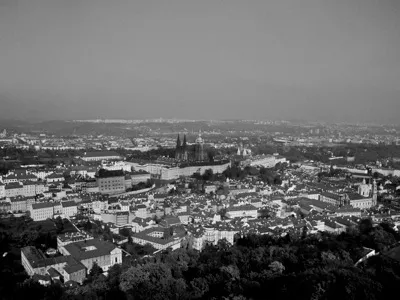
Now I must be careful here: living and visiting the Czech Republic are two different things. I have seen a very different picture of the Czech Republic than my family will when they arrive in just under two weeks. To them Prague will be “The City of a Hundred Spires.” It will be romantic, and beautiful, and purely mind blowing. I on the other hand see Prague differently. It is a city that exists, “In spite of our history” as Tomáš Masaryk, the first president of the Czechoslovak Republic, once said. I see the Prague that was communist, fascist, and democratic, all at the same time. I see the Prague that had to fight to raise those hundred spires into the air.
I have often wondered if the Czechs realize where they live. And it’s not to say that they are dumb, and are missing their history. But their history is not bright and happy. It is dim and painful. This country, and in particular this city, was very lucky during the wars. They were not destroyed like Germany was. They do not have death camps like Poland does. They never had the true horrors of the Soviet communism in Russia did. Yet still they suffered from lacking an identity to which they can all aspire. There is no “American Dream” here. They struggle with such an idea. The social toll that history has had in the Czech Republic is unfathomable for me. I see the remains of these eras, long past, yet the social undertones remain. There is a new generation coming up that has never lived through these times, and they will help to define the Czech future. I have no doubt that it will be bright. But the change will be slow.
I would be lying if I could tell you where this country will be in ten years. Four months hardly makes me an expert. It hardly makes me a novice. But still I have seen certain undertones of hope. They are small, and fleeting, yet exist within the hearts of the Czech people. They will do it together, just like they have in the centuries before, and just as they do it everyday. Little things. Little acts of kindness. A fleeting smile at someone you pass on the street.
And at risk of sounding like Deval Patrick, the (loser) governor of Massachusetts, maybe together they can.
E Pluribus Unum.