A Crash Course in Prague
The Pain Continues
So bed was at 5am. I got up at 8:30 to finish my final.
That took me until about 1 or 2pm, to then run across the city to get the keys for the apartment. My family is arriving tomorrow!
On the way home I picked up my ham. The 8 kilo ham. 17.6 pounds of ham. It’s bigger than some small children.
So I get home. Finish editing my paper (which, for your reading pleasure is below) and prepared the ham to go into the oven. Which barely fit. According to the recipe I was following it was going to take 3 hours to heat the ham, which was already cooked (thank God).
So the ham went in at 5. I left at 5:30 to go to class to collect my final from English Literature. I tried to stop to get my pictures, but even though they had said they would be ready, the photo store was lagging behind. So I just went to collect my final.
And to my delight, it was an “A”. And that means I earned an “A” in the class overall. But she suggested I read some feminist literature... So when I get back to the States, I will.
I headed home, to check on my ham, which Jack was kind enough to keep an eye on while I was collecting my final.
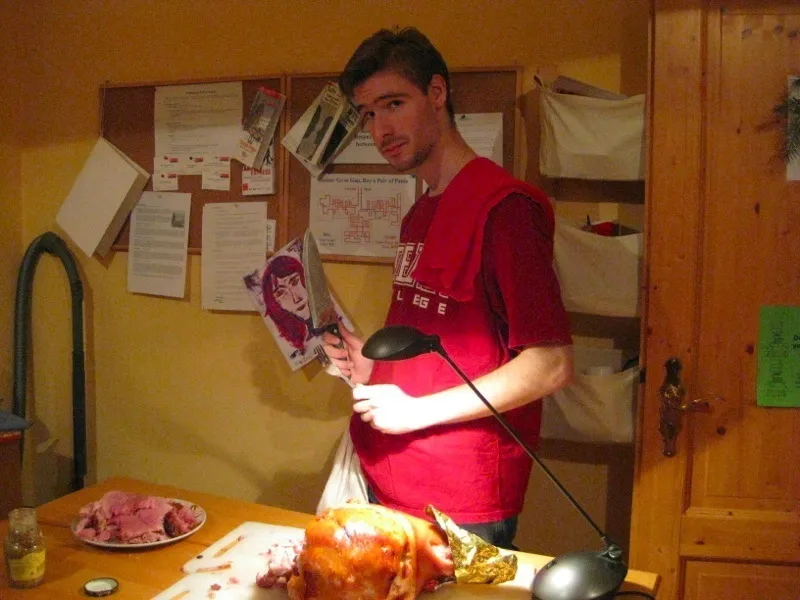
I opened the door and from 6 flights down I could smell it. So, I guess I was doing well. The potluck was at 8:30, and as you can tell by the picture at the top, I setup my own serving station for the ham. Which, big surprise, was amazing. Like I have said so many times before, the Czech’s really have this pork thing down pat.
After the potluck we all opened Secret Santa presents. It was so exciting to see what everyone received. I was gifted the “manliest highball glass in Prague” and a shot of Black Label to fill said glass with. Special thanks to Secret Santa Steve.
After Secret Santa was over we were treated to a fireworks show off the balcony, as one of the Secret Santa presents was fireworks. Pretty darn cool.
So it 10:30ish and I’m still running around, cleaning up my kitchen, the common room, and everything else, trying to get out the door to go out with everyone.
And at 11:20 I succeeded in doing just that. We went out to the club we always landed at during the semester. I stayed until 2ish, and got home around 3:30ish. Only to eat something, and discover that my family’s flight was due to land at 5:23am. So I showered, dressed, and dashed out the door as everyone else was coming in from the club.
I arrived at the airport at 5:30, yet the flight didn’t land for another 15 minutes. at 6, before they emerged, I went to Starbucks and grabbed a hot chocolate as I was about to fall asleep standing up.
I collected the weary travelers, took them back to Malá Strana where the apartment is, and got them settled.
I hopped the 22 tram for home and nearly passed out unconscious (not sleeping passing out) on my way home from over tiredness.
But I made it, and climbed my 11 flights of stairs, to crash land in my bed at 8:30am.
Sleep to awake ratio: 2.5 hours sleep to 24 hours awake.
The essay written for my law class is below. Enjoy.
They close at three o’clock every day, and if the Prague transit system didn’t run on time, I would have likely missed my chance to obtain the necessary resources to write this essay. They are called the Documentation Centre of Property Transfers of Cultural Assets of WWII Victims, yet the signs read, “Centrum pro dokumentaci majetkových převodů kulturních statků obětí II. světové války” and their only job is to restore lost pieces of art and other cultural artifacts to survivors and decedents there World War II survivors. They are in a six story white building, in a quiet square in the northern end of Prague, if I didn’t know any better I would say it were apartments, or a doctors office. Yet I made it up the six flights of stairs, to a small unmarked door with a ceiling hung lower than the floors beneath me; thirty-five minutes past two, record time, I knock. To my delight I am in the right place, and am able to buy the books I need, even though one is entirely in Czech, to complete the following research.
World War II lasted six years, but still today has carved out cultural implications that will last for many decades still to come. Beyond the horrors that occurred in the death camps of Germany and Poland, another great tragedy was occurring across all of Europe: the looting, confiscation, and redistribution of countless, and priceless, works of art. When the war ended in 1945, and the displaced peoples and attempted to return to society they had nothing. Absolutely nothing: no homes, no food, no furniture, missing friends and family, no lives to which they could resume. Organizations were quickly fashioned by the governments, including by the Czech government, to assist those in need, beginning to restore pieces of fragmented lives; a blanket and linens here, kitchen utensils there. Life was the number one priority, yet as soon as these needs were fulfilled, or at least partially so, the question of the lost culture came into view. Prague, and other central European cities, had stockpiles of artifacts that had been taken by the Third Reich. The same organizations that were working on restoring the everyday needs of WWII victims also assumed the new role of cultural asset distribution. The agency has been called many names over the decades, yet their purpose is the same as it is today: return what was wrongfully taken.
This is, no doubt, a daunting task. WWII is only going further into the past, and with the death of each remaining survivor, so too is more information lost. Immediately following the war there were several initiatives put forth to restore cultural property to its rightful owners, yet, as previously mentioned, the needs of the people often took priority. Today, however, Europe is a changed landscape. Progress has been made unilaterally since the end of WWII, ultimately ending in today’s European Union. Yet even though the majority of the countries in Europe are now considered as democratic, there are several legal issues pertaining to the restoration of art and other cultural artifacts.
In keeping a focus on Eastern Block countries, such as the Czech Republic, Hungary, and Poland, it must be noted that the legal system differs vastly from the legal system in the United States. In the US the basis is “common law” which is implicit, with the majority of the reasoning coming from judges through trails, this is in contrast to “civil law” which is practiced in the aforementioned countries. Civil law is explicit, in that weight is placed on scholarly ideas, rather than actual cases. Civil law also tends to reject the idea of an “automatic right” to anything, favoring instead a law explaining specific ideas in depth. In crude terms, under civil law, if there is no law for or against a particular right, then there are no grounds for that right. It is for this reason that restoration of art and cultural objects to WWII victims is particularly difficult: until recently the laws have not been on the books to support claims. For example there is a loophole in Czech law which states that if a court has an undecided restitution claim for more than seven years, they can claim that they do not have enough information, and make no decision. The Czech constitutional court has yet to address this issue.1
This is not to say that laws do not exist regarding the restitution of art to WWII victims, they do, yet their effectiveness is questionable. Resolution 212/2000 for example is an attempt to fortify preexisting laws regarding restorations. However there are critics of such decree, pointing out that it has arbitrary language, and lacks sanctions in the event it is not abided. Several other laws exist within the Czech Republic, however they too have issues with the syntax and implementation.
Oddly enough many of these decrees, as well as other non-law based arbitration guidelines for the return of confiscated art, contain the phrase “good will.” This inclusion within law and other documents presents another set of problems. Often times disputes over a piece of art exist between a museum or a private collector and an individual. The individual making the claim will willingly enter negotiations for restitution or compensation, yet larger organizations or collectors will err on the side of caution. The International Council of Museums (ICOM) is a non-legal based group that will help with such restitution mediation between parties but, “ICOM’s involvement in the process is only to facilitate the initial mediation process, and the organization will not be party to any dispute.”2 To put it bluntly, their philosophy here makes perfect sense; ICOM is not a legal organization, rather a conduit to successful negotiations.
This brings forward another fundamental question: which is better, restitution, or compensation; furthermore, which, if any of the restitution theories should be universally adopted? Pulling from French restitution law it has been found that, “claimants, tend not to prioritize compensation, preferring—where possible—the restitution of the works.”3 This, even in light that there are occasionally substantial sums offered in lieu of the restoration. Two notable claims were for 1.5 million Euro, the other for 225 thousand Euro. However during the 1960’s when several restoration cases were ongoing, compensation, “in 50 percent of these re-investigated cases [during the late 1990’s], it was found that the compensation provided in the 1960’s did not cover even half of the value of the loss.”4 This is an obvious and major problem with compensation; how does one assign a value to a “priceless” work of art? This is a question that is not easily answered, and in the context of this essay will not be answered, rather warrants a closer, individualized look, at the fundamental question of, “what is art?”
Working from this point, as to where restitution sits in the system, Dr. Kamil Zeidler, Head of the Political Section of the Minister of the Interior and Administration of the Polish Republic, puts forth a triangle diagram for solving restitution cases. At the top of the triangle is morality, with politics and law on the other corners. In the middle is the restitution case. He explains that the case can be skewed one direction or the other depending on the circumstances, thus there are times when the law will be unable to decide the correct course of action for a restitution case, politics will take precedence where political relations are most pertinent, or the law will reign supreme. Here again Zeidler connects a restitution case to the idea of “good will.” He goes on to describe several other issues beyond good will, including lack of documentation and lack of a universal law.
Thus the second question comes into view: how should restitution theories be handled? The most common, and best known, is restitution ad integrum, or restitution to the original state. Here the original owner, or descendant, would ultimately own the moral rights to the artifact claimed. Other theories include: the theory of safest place, theory of common use, and the theory of place of origin. These do, for the most part, speak for themselves, yet Zeidler points out, “these theories can be highly contradictory.”5 Common law tends to follow the ad integrum principal of restitution, however there are strong arguments for and against all the theories listed here, and other lesser-known ideologies. Again this reintroduces the question, “who owns art?”
The Czech Republic has, whether on purpose or accident, stood more for the theory of common use. This is the case for several reasons, namely the statue holding that only citizens of the Czech Republic can reclaim lost artifacts, but more importantly, and on a larger scale, the Czech Republic has a dirty secret. Several of their museums, including the three largest, consist either mostly, or entirely of confiscated art. The National Museum (and their archives), the Museum of Decorative Arts, and the Jewish Museum have such art flowing through extensive galleries. While they have cooperated with respondents to the restitution act, they often purchase back the art that has been reclaimed.6 This further questions the moral implications of art ownership, and several organizations have stepped up in helping to answer these questions.
The United Nations Educational, Scientific and Cultural Organization (UNIESCO), the International Council of Museums (ICOM), the International Council of Monuments and Sites (ICOMOS), and the International Centre for the Study of the Preservation and Restoration of Cultural Property (ICCROM) are just a few, if not the largest, organizations to attempt to answer some of the questions surrounding the morality of art. They work together, with the governments of Europe, to find laws that can be both unilateral and moral. Although such laws have yet to be established regarding the restitution of art after WWII, suggestions have been made and successfully seeded across Europe, namely the free movement of goods. Already part of European Union law, the movement of goods statue allows for the art to pass through borders without trouble, allowing for restituted goods to be returned quickly, safely, and legally.
Such movement is undoubtedly part of the future of restitution law, yet here again there are constraints by the system of civil law. Under civil law, as it is currently written in the Czech Republic and other Eastern Block countries (namely Poland), it is not possible to retroactively institute the law. In an earlier paper by Zadar he states that, “The most important consideration for the future of cultural heritage restitution and protection is the necessity to build a three-dimensional system of protection and restitution, to achieve unification of solutions, and to coordinate activities.” The three-dimensional system Zadar speaks of is the public international law, internal law, and European community law. He goes on to discuss the economic implications of such law which also puts forth an interesting question: when it comes to restitution what is best for the economy? If the government is (like they are) spending large sums of money to regain art that has been reclaimed, or issuing large compensations, it may be more sensible in the long run for that money to be used in other social programs; perhaps then the art should remain unclaimed. Yet, if the art returns to the free market, then perhaps it is better that it be freely traded. There is no correct or incorrect answer as a whole, and ideology will vary widely from country to country based on the current state of their economy. However, as the world economy weakens, and governments are now required to provide more social support, then perhaps the money should remain in other programs, leaving these restitution projects for another day, but as previously mentioned, the war isn’t getting any closer. Records are not becoming more prolific. People are not remembering more about the past.
While the passage of time is undeniable as a major setback, the internet is a major advance in restitution of art. The internet provides a vehicle for large-scale distribution of information, hosting of catalogues, and processes for restitution, yet it has some drawbacks. Beginning with the advances provided by the internet, searchable databases are one of the most important implications overall. Internet penetration is spreading every day, which means that more people will have the ability to reclaim their lost heritage and cultural artifacts. In one instance a Researcher at the Virginia Museum of Fine Arts noticed a painting on a Polish website of missing cultural artifacts. After confirming that the museum did have the painting in their possession it was successfully restituted to Poland.7 Other countries, including the Czech Republic, have created such databases of both missing art and potentially looted art that are accessible to the general public for research and reclamation.
Still there exists several issues with the deployment of internet restitution methods. First and foremost is the lack of information. “The National Archives and Records Administration (NARA) in Maryland has several million pages of documents on Holocaust-era assets alone,” claims Shauna Isaac, the director of Trace Looted Art, a database hosted in London of Holocaust-era looted art. She goes on to explain that it would take vast amounts of time and money to digitize all these records and publish them online, a project that would have returns that are unknown. It is very possible that such initiative could restore thousands of pieces of looted art and cultural artifacts, however it is just as likely it would result in diminishing returns. Beyond missing information it takes a large workforce to maintain such databases, which can also be cost prohibitive. Hope however, is in the future; Web 2.0 as it is called will likely help to overcome these issues.
Web 2.0 is the next generation of web-based communities. Wikipedia, Folksonomy, and other social networking sites such as Linkedin or Facebook, are providing unusual conduits for the restitution of looted art and cultural artifacts. People are actively able to search through these communities, some of which are even dedicated to entirely to Jewish genealogy. These sites and other open communities will likely play a much larger role as restitution continues. But one more hurdle exists: copyright issues.
Yes, of all things, copyright issues with posting pictures of missing or looted art objects, or excerpts from missing books (missing books is an entirely different, and substantial case beyond art) have been brought up. Isaac claims, “One way around this is to purchase the rights to the images, but given the amount of funding available, it is difficult to do this.”8 Although many times images of missing art do not exist, no statue exists, in either the US legal system or the European Union, to allow breech of copyright of selected works for restitution purposes.
Copyright, however, has not been the problem in Slovak restitution case law, rather the syntax of defining what an “asset” is. In 2003 a case was brought forth for the reclamation of missing artifacts, which the Lower Chamber upheld, and returned the cultural artifacts, yet the Grand Chamber overturned the verdict. The basis for the case was the way the Grand Chamber dealt with the terminology “genuine dispute,” and “legitimate expectation” when it came to the restitution of the “assets”. Instead of holding like the Lower Chamber, that the claimant has a legitimate expectation to the missing artifacts (coins in this instance), instead followed a test that required the claimant to know the location of the missing artifacts. As the claimant was obviously unable to located the looted artifacts, he could not claim they were an asset, thus he had no legitimate expectation to have them returned.9 This would likely not hold in a US court of law, but again, the civil legal system, and inherent problems within current laws regarding restitution, allowed this legitimate restoration of missing artifacts to go un-restored.
Drawing from US case law will not help in restitution cases, as there are no US cases surrounding such ownership. The closest thing the US has to WWII, that occurred on domestic soil, was the Civil War. Here the salves were freed, yet they had no property or assets to speak of that needed to be returned. Several reasons exist for the lack of legislation on restitution exist beyond this scope, chiefly the lack of history in the US. Bohemia and Moravia were established in the 9th century. Art across Europe has been created since the millennium before Christ; in the US, aside from Native American art, has only been created since the late 1600’s… Three thousand plus years of history and art as opposed to three hundred plus years. Such facts are indicative of the US having significantly less art that could be stolen the first place. High Baroque art was the style in Europe while the pilgrims were looking for a place to live in Massachusetts; St. Nicholas Church in the Old Town Square of Prague was being constructed in 1735, the same year that Paul Revere and John Adams were born. This fundamental difference between the US and Europe changes the entire dynamic of art legislation, the ideology behind art itself, and the public image of art as a whole. US law is simply not present for consultation in European art restitutions, or for that matter even relevant. Furthermore the question of morality in art restitution will be answered fundamentally different between the US and Europe, again, particularly different in the Eastern Block.
These fundamental ideas are different because of another major change in the politics in Central and Eastern Europe; the Iron Curtain fell in 1945, and in 1948 there was Red flag over Prague Castle. Soviet rule came in just three years after the fall of Nazi rule, as if one horror is better than the other. Communism lasted in the Czech Republic, then Czechoslovakia, until 1989, when the last of the six regime changes in the 20th century took place. Communism certainly left a mark, if not a scar, on the Czech lands and other Eastern Block countries. The rule also had a profound influence on art restoration. Art was confiscated again, except instead of by the Nazi’s, by the Soviets. Restoration projects became strained, yet art was placed in museums for all to enjoy, part of the communist mentality of equality. The implications of communist rule in the Czech Republic has yet to take its full effect, as pieces are still being assembled into a more democratic state, albeit heavily socialized.
One of the practices that was instituted under communism was the unlawful nationalization of private property, in that the art designated for restitution was now owned by the state for display in museums, or whatever use the state saw fit. Zeidler here points out, “This is still a problem in Poland… [Where] it should be stressed that there is still no comprehensive set of legal regulations which would give the victims of the Second World War and communism legal tools for regaining their property in the cultural goods category.”10 In the Czech Republic on the other hand, while this is also a problem, a large number of restitutable assets were liquidated during the 1950’s, furthermore applications were approved by the National Assets Administration Authority (NSMP in Czech) for the loan or issue of items to cultural to cultural and educational institutions. This included law books to Charles University, antique furniture to state offices, and other catalogues of literature to libraries.11 Such pieces will likely remain lost in the fray and will never be returned.
Thus the future of restitution must be further examined. As has been previously noted records and files will likely become increasingly important. Yet, in 2002 Prague suffered the worst flooding in over 300 years destroying much of the city causing 500 million plus Koruna (~30 million USD) in damage. The Central Depository of the Prague City Court, where nearly all the archives and records of the confiscated art in the Czech Republic were housed, was among the buildings destroyed. In order to save the integrity of the information it was frozen. The thawing and drying process just began in 2005.12 This was no doubt a major setback of the restitution of a large amount of art and cultural artifacts. Jan Ryba, a former professor at Charles University and current employee of the City of Prague Archives, says explains, “Prague courts dealt with around 5,000 restitution cases. This high number is partly due to the fact that many legal entities—nationwide bodies opposing the restitution claims—were based in Prague. After studying the available files, it can be stated that most of the cases dealt with real estate and moveable property generally concerned cars and securities. Other moveable assets, including works of art, make up a tiny fraction of the cases.”13 Restitution of art has not been the priority that it should have been in the Czech Republic.
This is only further evidenced by my experience, in finding the Documentation Center; in a small, quiet square in the northern end of Prague. And furthermore that Prague’s museums are pregnant with such art and artifacts. Every two years the Documentation Center holds a conference and publishes their proceedings. They have been referenced throughout this essay as such. The issue of prioritization comes into view here; where do the Czechs, and those in the Eastern Block countries, place their priorities? Their actions have shown that it is mainly in the idea that art is ultimately for the people, regardless of how it was obtained. Without the laws in place to support another view, it will likely remain this way, with an asset returned here or there. Even with the implementation of the internet into the restoration of cultural assets and works of art there is still much work to be done. Archives need to be sorted and organized, data needs to be published, and funding must be allocated. These are tall orders in the tough economic culture the world is facing today, yet if the wrongs of WWII, and communism for that matter, are to be righted then these are necessary steps the governments in Europe must consciously make. Universal laws, at least in regards to restitution, will likely become necessary for these items to be returned to their owners. The European Union is a step in that direction, yet there are many more steps to be taken before there will be real solutions.
While many scholars contend that it comes down to law in issues of restitution, I prefer Dr. Kamil Zeidler’s view: “The problems of restitution concern not only lost cultural heritage. In many cases we know where the work of art is. However, obstacles are faced when a material part of the cultural heritage is actually lost. In such cases, we are likely to talk about compensation. But compensation will not return a work of art. When a cultural asset is missing permanently, all of mankind suffers.”14 Thus, law may never have a definition of art, or who owns it, but I know that the definition exists in what we call humanity.
Works Cited & Referenced
1 Pejchal, Aleš. Problems of Restitution According to Act no. 212/2000. From Restitution of Confiscated Art Works—Wish or Reality? Trans. Christopher Hopkinson. Prague: Tilia, Šenov u Ostravy, 2008. Pages 73-79.
2 Kadlec, Miloš. Practical Experiences with the Restitution of the Contents of the State-Owned Sychrov Chateau. From Restitution of Confiscated Art Works—Wish or Reality? Trans. Christopher Hopkinson. Prague: Tilia, Šenov u Ostravy, 2008. Pages 20-25.
3, 4 Kalfon, Lucien. The Situation in France—Between Restitution and Compensation: The complex question of reparations viewed by the CIVS—looting of cultural property. From Restitution of Confiscated Art Works—Wish or Reality? Trans. Christopher Hopkinson. Prague: Tilia, Šenov u Ostravy, 2008. Pages 80-85.
5, 10 Zeidler, Kamil. How to Get and not to Give. About Injustice in Restitutions. From Restitution of Confiscated Art Works—Wish or Reality? Trans. Christopher Hopkinson. Prague: Tilia, Šenov u Ostravy, 2008. Pages 93-98.
6 Jirásek, Pavel. The Situation in the Czech Republic Five Years After the Adoption of the Restitution Act no. 212. From The Future of the Lost Cultural Heritage. Trans. Christopher Hopkinson. Prague: Tilia, Šenov u Ostravy, 2006. Pages 335-338.
7, 8 Isaac, Shauna. The Role of Technologies in Finding Looted Art. From Restitution of Confiscated Art Works—Wish or Reality? Trans. Christopher Hopkinson. Prague: Tilia, Šenov u Ostravy, 2008. Pages 205-212.
9 Pejchal, Aleš. Restitution According to the Ruling of the European Court of Human Rights. From The Future of the Lost Cultural Heritage. Trans. Christopher Hopkinson. Prague: Tilia, Šenov u Ostravy, 2006. Pages 63-69.
11 Krejčová, Helena. Post-War Restitutions in Czechoslovakia. From Restitution of Confiscated Art Works—Wish or Reality? Trans. Christopher Hopkinson. Prague: Tilia, Šenov u Ostravy, 2008. Pages 43-63.
12, 13 Ryba, Jan. Restitution of Works of Art According to Act no. 128/46 in the Files of Prague Law Courts. From The Future of the Lost Cultural Heritage. Trans. Christopher Hopkinson. Prague: Tilia, Šenov u Ostravy, 2006. Pages 298-310.
14 Zeidler, Kamil. European Legislation in the Field of Cultural Heritage Restitution. From The Future of the Lost Cultural Heritage. Trans. Christopher Hopkinson. Prague: Tilia, Šenov u Ostravy, 2006. Pages 33-43.
Webster’s Dictionary